Ask Lumos is a series from Lumos PV, answering the questions we get asked most often about solar, batteries and home energy. Based on Worton Park, Oxfordshire, we work with homeowners, businesses and community organisations across Oxfordshire and the Cotswolds. Visit our Resources Hub to view some of our recent projects.
Energy storage is one of the fastest-growing areas of the renewable energy market, and it is not hard to see why. Whether you are a homeowner looking to reduce your electricity bills, a business wanting to take control of your energy costs, or a community organisation working towards a lower carbon footprint, battery storage can make a real difference to how much you spend on electricity and how much you rely on the grid.
Here is everything you need to know.
How does battery storage work?
A battery stores electricity so that you can use it at a time that suits you, rather than at the moment it is generated or drawn from the grid.
If you have solar panels, your battery will charge during the day when your panels are producing more electricity than you need. You can then draw on that stored power in the evening, overnight, or on cloudy days, rather than buying electricity from the grid at a higher rate.
Without solar panels, a battery can still save you money. By charging overnight on a time-of-use tariff, when electricity is cheapest, and discharging during peak hours when rates are higher, you can significantly reduce your bills. Tariffs like Octopus Go and Intelligent Octopus Go are designed with exactly this kind of flexibility in mind.
For businesses, the same principle applies at scale. Sites with high daytime energy usage can pair batteries with solar to reduce reliance on expensive peak-time grid electricity, while organisations on time-of-use tariffs can use storage to shift consumption away from their most costly hours. For schools, community centres and commercial premises, this can translate into meaningful reductions in operating costs.
Most battery systems connect to your existing electrical setup and are managed by a smart inverter or energy management system, which takes care of when to charge and discharge automatically.
Battery myths
You need solar panels to benefit from a battery: Not true. While solar and battery storage work brilliantly together, a standalone battery can still deliver meaningful savings if you are on the right tariff. The payback period will typically be longer without panels, but many homeowners and businesses find the combination of lower bills and greater energy independence more than worth it.
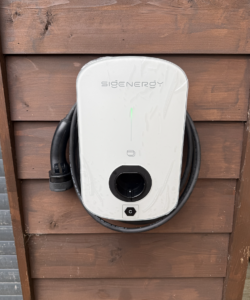
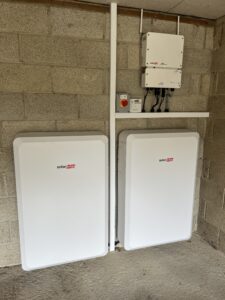
Batteries are too big and intrusive: Modern battery systems are compact and unobtrusive. For domestic installs, wall-mounted units from brands like GivEnergy, which Lumos PV install as a preferred supplier, are designed to sit neatly in a garage, utility room or hallway. For commercial and community sites, systems are scalable and designed to work within the constraints of the building, whether that is a plant room, outbuilding or rooftop enclosure.
They are not safe: Battery systems installed by accredited professionals are safe, reliable and designed to last. MCS-accredited installers like Lumos PV follow strict industry standards on installation and commissioning, so you can be confident the system is set up correctly from day one.
They do not last long enough to be worth it: Most modern batteries carry a warranty of around ten years, with many systems expected to perform well beyond that.
How much energy can a battery store?
Battery capacity is measured in kilowatt-hours (kWh). To put this in context, the average UK home uses around 8 to 10 kWh of electricity per day, while a school or community centre might use anywhere from 50 to 100 kWh or more, depending on size and activity.
A typical entry-level domestic battery sits at around 5 kWh, which would cover roughly half of an average household’s daily usage. A 10 kWh battery could, in the right conditions, cover a full day’s consumption. Many systems are modular, meaning you can add capacity over time as your needs change or budget allows.
For commercial and community sites, larger modular systems can be configured to match higher consumption patterns. The principle is the same: store cheap electricity when demand and rates are low, use it when they are high.
To give a practical example: a 10 kWh battery, charged overnight on a cheap tariff, could power lighting, appliances and phone charging through the following evening without drawing from the grid at peak rates. Add solar panels, and you could cover the vast majority of daily usage without touching the grid at all for much of the year.
What can you expect to save?
Savings vary depending on your energy usage, your tariff, and whether you have solar panels.
For homeowners, a battery paired with solar can save a typical household anywhere from £500 to £1,000 per year, depending on system size and usage patterns. The payback period for a combined solar and battery system is typically in the region of seven to ten years, with panels now at their lowest ever price point. A standalone battery, used with a time-of-use tariff, can save in the region of £200 to £500 per year.
For businesses, schools and community organisations, the picture is often more compelling. Higher energy consumption means greater exposure to peak-rate grid electricity, and therefore more to gain from storage. Sites with significant daytime usage, such as schools running during term time or commercial premises with high operational energy demand, often see faster payback periods than domestic installs. When combined with solar, the savings can be substantial.
The sooner a battery is installed, the sooner it starts working for you.
Where can a battery be installed?
Most properties are suitable for battery storage. For domestic installs, the battery needs to be in a dry, ventilated indoor space, such as a garage, utility room or cupboard, located close to your consumer unit to keep installation straightforward.
For commercial and community sites, our team surveys each property individually to identify the best approach. We have experience across a wide range of settings in Oxfordshire and the Cotswolds, from standard residential properties to schools, community centres, agricultural buildings and commercial premises. If you are unsure whether your property is suitable, we will assess this during an initial survey.
How much does a battery cost, and how can I fund it?
The cost depends on the capacity you need and whether the battery is being added to an existing solar system or installed as a standalone unit. As a guide, a 10 kWh battery system, fully installed, typically costs in the region of £4,000 to £7,000 for domestic properties. Commercial systems vary considerably depending on scale and site requirements.
Battery storage is not currently subject to VAT, which keeps the upfront cost lower than it might otherwise be.
For homeowners, the government’s Warm Homes Plan, formally launched in January 2026, includes low and zero interest loans to help fund green home improvements including battery storage. The Consumer Loan Scheme is expected to launch in April 2027 through banks and mortgage lenders, with eligibility details still to be confirmed.
For businesses and organisations, there are additional financial levers worth exploring. Capital allowances allow businesses to offset the cost of qualifying energy equipment against their tax bill, which can significantly improve the economics of a battery install. Some energy tariff providers also offer incentives for battery owners, and it is worth exploring what is available through your current supplier. We would be happy to talk through the funding options that are most relevant to your situation.
What next?
If you would like to explore whether a home battery is right for your property or business, our team would be happy to talk it through. And if you are also considering solar panels, our Ask Lumos guide to how solar PV systems work is a useful companion read.
Lumos PV are based in Worton, just outside Oxford, and work across Oxfordshire and the Cotswolds, with experience across domestic, commercial and community projects. Get in touch to arrange a survey, or use our cost calculator for an initial estimate.