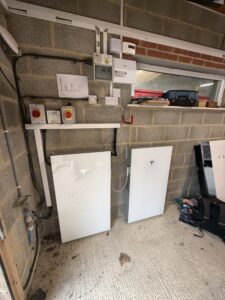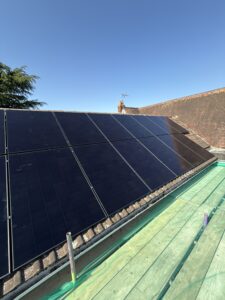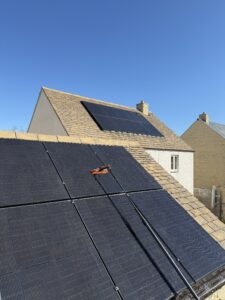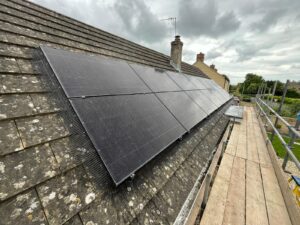
This project involved a solar and battery storage installation, designed to maximise energy independence, reduce electricity costs and keep the property powered during outages.
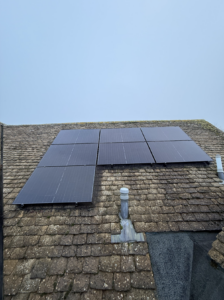
15 panels were installed, combining AIKO’s high-efficiency back contact technology with Trina’s all-black modules, paired with a Tesla Powerwall 3 and Backup Gateway. The result is a system that generate, storage and manages electricity intelligently, making the most of every unit produced.
System highlights
- 3 x AIKO Neostar 3S 475W ABC N-Type panels
- 12 x Trina Vertex S 420W all-black panels
- 6.465kWp total system size
- 1 x Tesla Powerwall 3 (providing 13.5kWh storage)
- 1 x Tesla Backup Gateway
What does this mean?
Based on typical UK conditions, the system is expected to generate around 5,700kQh of electricity a year. On a good summer’s day, that can be between 25 and 35kWh. In spring and autumn, it typically falls to around 10 to 20kWh, and in winter, to between 3 and 6kWh. With 13.5kQh of battery storage, any surplus solar generated during the day can be stored for use in the evening and overnight, rather than exported back to the grid.
For a typical household, that translates to self-sufficiency levels of up to 90% in the summer, 50 to 70% in spring and autumn, and 15 to 30% in the winter. The Powerwall can also be charged up from the grid during low-cost tariff periods, meaning cheaper electricity is stored and used when prices are higher. This keeps the battery working hard through the winter, when solar generation is lower, and helps reduce the impact on the household of rising energy bills.
Key benefits
Whole home backup: If there are issues with the grid, the Backup Gateway automatically disconnects the property and switches to stored energy, providing power to essential circuits or the whole home, depending on the system design
Off-peak charging: The Powerwall charges overnight on low-cost tariffs and discharges during peak-rate periods, reducing electricity costs year-round.
Using more solar energy: Stored energy can be used in the evenings and overnight, when typical household demand is highest, rather than being exported to the grid.
Intelligent energy management: Tesla’s monitoring platform automatically optimises charging and discharging, based on solar production, household consumption and tariff settings.
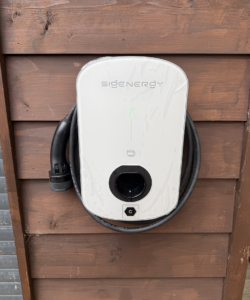
EV ready: The system has the capacity to support an EV charger in the future, allowing most of the charging to come from solar power.
Thinking about solar for your home? Get in touch to arrange a free estimate.